Case study — 2025
Celebrato OS
From a simple proposal tool to a project-centric operational system.
Celebrato OS started as a simple tool for keeping project proposals organized. As the workflow became more complex, more information needed to stay connected — client details, production notes, costs, tasks, files and documentation. The proposal was no longer the center. The project became the center.
Celebrato OS evolved into a project-centric operational workspace designed to connect the different operational activities required to deliver custom creative projects.
- Product Design
- Systems Thinking
- Information Architecture
- Workflow Design
- AI-assisted Prototyping
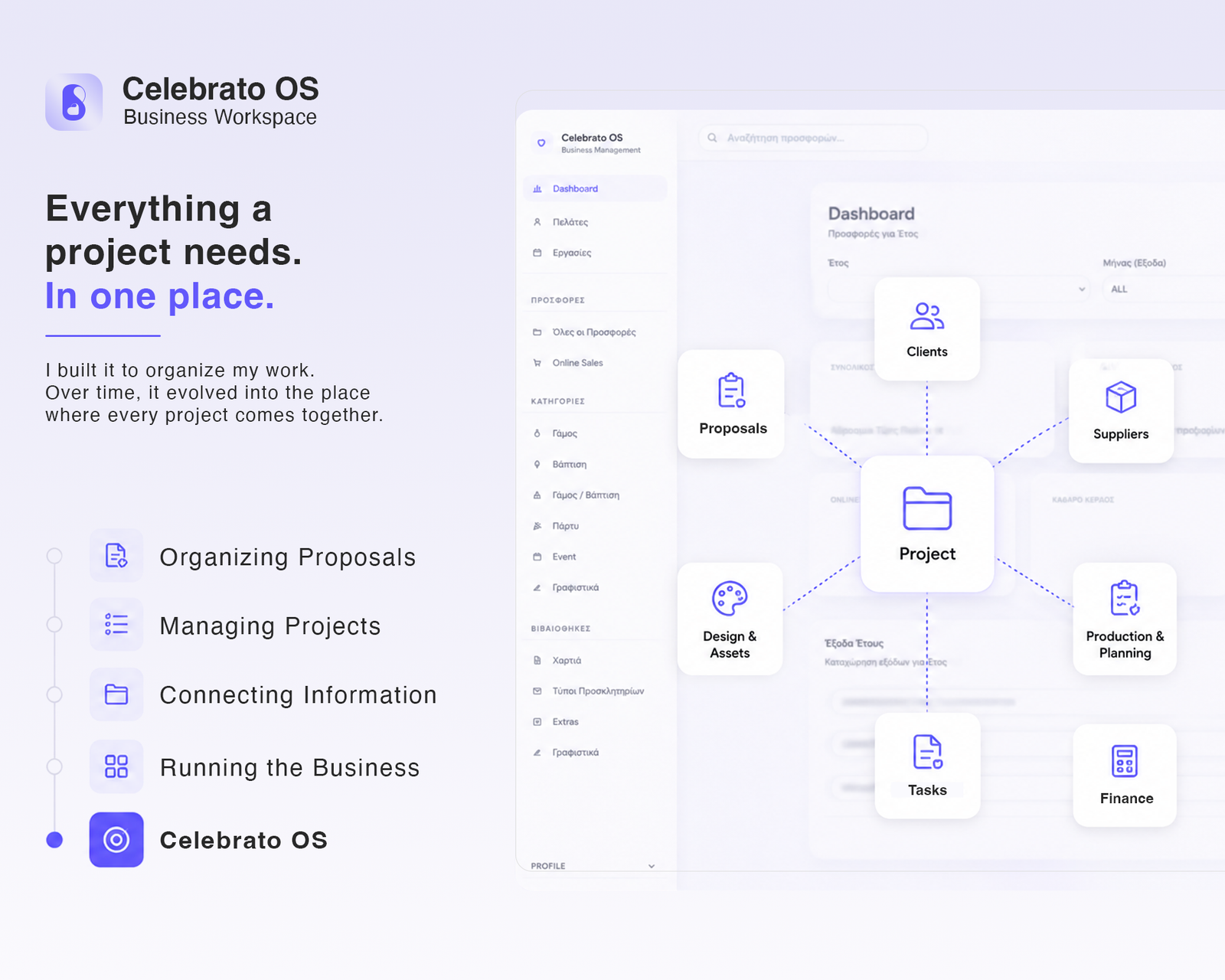
Celebrato OS, operational workspace
01 — The starting point
It started with a simple problem
The original idea was to create one place to keep project proposals organized.
But as the workflow became more complex, the proposal alone was no longer enough. Each project generated additional information and operational tasks that needed to stay connected.
- Client details
- Production notes
- Costs
- Tasks
- Files
- Documentation
The challenge became bigger than managing proposals.
02 — The shift
The project became the center
Instead of treating proposals as isolated documents, I reframed the product around the project itself.
A project became the central point connecting:
- Quotations
- Clients
- Tasks
- Suppliers
- Production
- Documentation
- Costs
- Libraries
This changed the product from a simple quotation-management tool into a broader operational workspace.
03 — What I designed
Designing the operational layer
Celebrato OS was designed to centralize the operational information needed to deliver custom creative projects.
Core areas include:
- Quotations
- Projects
- Client information
- Tasks
- Suppliers
- Production planning
- Documentation
- Cost tracking
- Reusable libraries
- Operational workflows
The goal was not to replace creative tools, but to create an operational layer connecting the information and processes around the work.
04 — From screens to systems
Working on Celebrato OS changed the way I approached the problem
I stopped thinking only about individual screens and started thinking about systems, workflows and how information moves through a business.
This meant looking at:
- How information enters the system
- Where it needs to go
- Which entities need to be connected
- Which processes are repetitive
- Where users need structure
- Where automation could reduce manual work
05 — Product structure
A project-centric architecture
The project sits at the center, connecting every operational entity required to deliver the work.
PROJECT
06 — Prototyping & building
From product thinking to a working prototype
The project was developed through rapid prototyping and AI-assisted building.
I used AI-assisted development tools to explore product ideas, test structures, iterate on interfaces and turn concepts into working digital experiences.
The focus was not simply on generating screens, but on exploring how the underlying workflow and system could work.
- AI-assisted Prototyping
- Product Design
- Workflow Design
- Systems Thinking
07 — What I learned
What changed through the project
Celebrato OS started as a small solution to a specific problem.
Through the process, it became an exercise in understanding how a business operates as a system.
The biggest shift was moving from:
“Which screen do I need?”
“What information, people and processes need to work together?”
08 — Still evolving
A living product, not a finished collection of screens
Celebrato OS is an evolving product concept, with further ideas around automation, notifications, calendar views, automatic task creation and other operational workflows.
The project is treated as a living product rather than a finished collection of screens.
09 — Final
A system built around the work
Celebrato OS represents the direction I am increasingly interested in: understanding how businesses work, identifying friction in their workflows, and turning those problems into structured digital systems.
- Product Design
- Systems Thinking
- Workflow Design
- Information Architecture
- AI-assisted Prototyping